
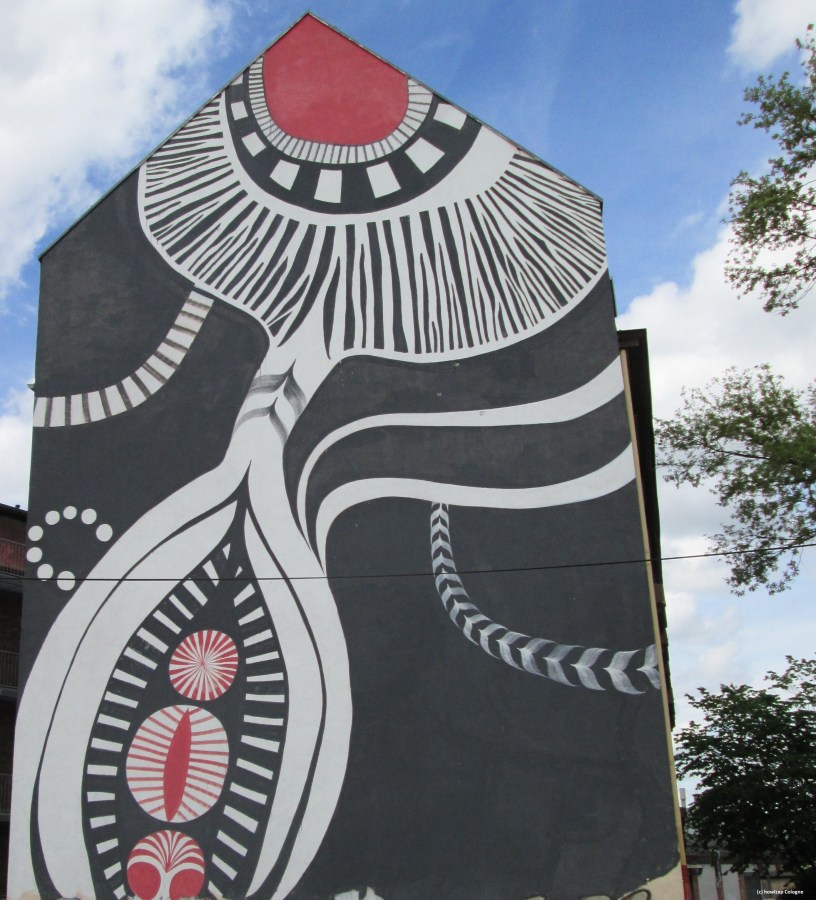
Bladder – Cologne Ehrenfeld – photo by (c) howlzap Cologne
In my experience, the idea of a cystoscopy is considerably worse than the actual thing. Although apparently men do have a more uncomfortable time as their urethra is longer.
It involves the urologist inserting a cystoscope through the urethra and into the bladder. The cystoscope is a flexible probe with a camera and the images are viewable on a screen.
In the examination room there’s a chair that flips back – like a gynaecologist’s – screen and curtained changing area with toilet. First, after peeing, I have to undress from the waist down and sit. Then the chair is pushed back into position and they insert some anaesthetic gel into the urethra which numbs everything before inserting a tube then the cystoscope. The tube is the worst bit but it’s more uncomfortable than painful and once that’s in I don’t feel anything else except the urge to pee, bizarrely. You can’t actually pee during a cystoscopy as fluid is being constantly flushed through the bladder but afterwards you need to, hence the toilet.
Then suddenly there’s a visual of inside my own bladder on the screen that we can all see. The bladder is pink and like the inside of an eyelid. The best-case scenario is always “no evidence of disease” (NED) and no nasty surprises!Recently I’ve found it helpful to take pictures with my phone.
Looking objectively at the whole procedure it’s been strangely wonderful to look my tumours in the eye so to speak. What other forms of cancer do you get such a view of them? It is shocking and terrifying; however, it is also reassuring that at a future check up I know I’ll see with my own eyes that my bladder is all clear and healthy again. This is what I visualize in the meantime. Fingers crossed for the next time for anyone going through it!
*Jetzt auf Deutsch*
Meiner Erfahrung nach ist der Gedanke an eine Blasenspiegelung wesentlich schlimmer als die eigentliche Untersuchung. Obwohl es für Männer offenbar unangenehmer ist, da ihre Harnröhre länger ist.
Dabei führt der Urologe ein Zystoskop durch die Harnröhre in die Blase ein. Das Zystoskop ist eine flexible Sonde mit einer Kamera, und die Bilder können auf einem Bildschirm betrachtet werden.
Im Untersuchungsraum gibt es einen Stuhl, den man zurückklappen kann – wie bei einem Gynäkologen -, einen Bildschirm und einen mit Vorhängen abgetrennten Umkleidebereich mit Toilette. Nach dem Pinkeln muss ich mich zuerst von der Taille abwärts ausziehen und mich setzen. Dann wird der Stuhl zurückgeschoben, und sie führen ein Betäubungsgel in die Harnröhre ein, das alles betäubt, bevor sie einen Schlauch und dann das Zystoskop einführen. Das Röhrchen ist das Schlimmste, aber es ist eher unangenehm als schmerzhaft, und sobald es drin ist, spüre ich nichts anderes mehr als den Drang zu pinkeln, seltsamerweise. Während einer Zystoskopie kann man eigentlich nicht pinkeln, da ständig Flüssigkeit durch die Blase gespült wird, aber danach muss man, deshalb die Toilette.
Plötzlich wird das Innere meiner eigenen Blase auf dem Bildschirm gezeigt, den wir alle sehen können. Die Blase ist rosa und sieht aus wie die Innenseite eines Augenlids. Das beste Szenario ist immer „kein Nachweis einer Erkrankung“ (NED) und keine bösen Überraschungen! In letzter Zeit habe ich es als hilfreich empfunden, Fotos mit meinem Handy zu machen.
Wenn man das ganze Verfahren objektiv betrachtet, war es seltsam schön, meinen Tumoren sozusagen in die Augen zu sehen. Bei welchen anderen Krebsarten bekommt man einen solchen Blick auf sie? Es ist schockierend und erschreckend, aber es ist auch beruhigend, dass ich bei einer zukünftigen Untersuchung mit eigenen Augen sehen kann, dass meine Blase wieder frei und gesund ist. Das ist es, was ich mir in der Zwischenzeit vorstelle. Ich drücke allen, die so etwas durchmachen, die Daumen für das nächste Mal!
 Bladdergraffiti